About Lambwe Christian School
Nelda continued to collect material and food for the children and would drive the 250 miles (400 km) of bad roads from Nairobi to Lambwe once a month to visit her deaf children and bring them food. She also had to raise funds for workers' salaries. She took care of every need at the school, whether it was medical, food, or school fees for those who had moved on to high school. Nelda was stubborn and principled and did not shy off from reprimanding corrupt education officers and any other person who did not have the well-being of the deaf children at heart.
When Enoch Aloo felt he was dying, he sent for Nelda and beseeched her to care for his deaf children. Nelda did just that until her old bones could no longer hold her upright. Mama Richard (Kenyan custom addresses a mother “Mama” followed by the name of her firstborn) was always on her feet to serve the children and provide for them. It was not until 2003 that the government recognized the school and took over payment of some of the workers’ salaries. Today, some staff still have to be paid by fundraising.
Nelda had a clear vision for the school and had an elaborate building plan for modern classrooms, hostels and dining hall drawn up for the school. Unfortunately she did not manage to raise sufficient funds for the huge project to take off. We still endeavour to construct our buildings according to her initial plans. In 2004 when she visited Kenya for the last time, she promised to get another coordinator.
Siloam became involved after a ‘chance’ meeting with Nelda in May 1995. She challenged our Director, Richard Norton, to help provide additional funds for ‘her’ children whom she described as being both deaf and ‘cursed’ because of the old tribal superstitions about sickness, deformity or disability being a punishment from the spirits for the bad things they had done! Today, awareness of deafness and other disabilities is greater and the families of the pupils have the opportunity to learn how to communicate and support the children. The carers of the many orphaned youngsters are included in these programmes. Activities between the different schools also help to break down the barriers of misunderstanding. However, there is still some ignorance in the community.
Update by Margaret Odhiambo, Head Teacher, amended by Martin Mackenzie and Richard Norton.
THE PHOTOS ON THIS PAGE WERE TAKEN IN MARCH 2017. THE GROUND SHOULD BE COVERED IN GRASS. THE DROUGHT WAS SUCH THAT THE MILK CATTLE HAD TO BE SLAUGHTERED BECAUSE THERE WAS NO WATER OR FODDER FOR THEM.
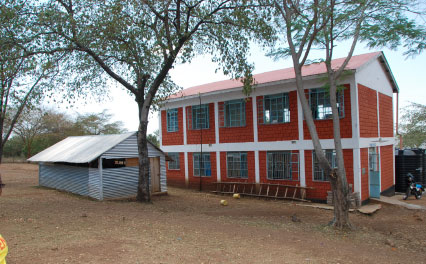
The girls’ dormitory. When it was built over ten years ago, Margaret had the foresight to have shower rooms and flush toilets included. These are nearest with the small windows. She is still waiting for the water system. Currently, the only washing facilities for children and staff are open to the elements with only a corrugated tin wall for privacy. Water, if available, is poured over the head.
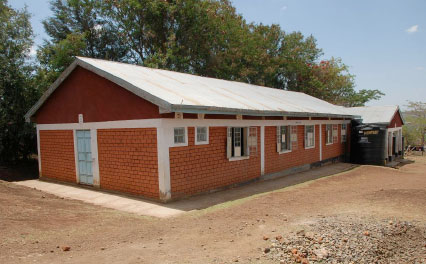
The on-site staff accommodation. As this is a residential school, at least one teacher must on be site.
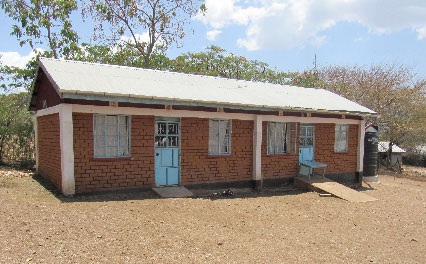
A generous company gave me 40 head torches which now enable the children to do their homework during the frequent power cuts. They can each focus on their work and have both hands free. We have also supplied solar powered lights for general areas as well. Here the children are signing “Hallelujah” thanking God for the gifts.
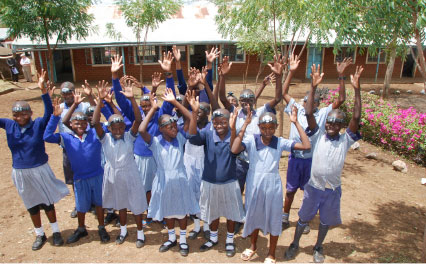
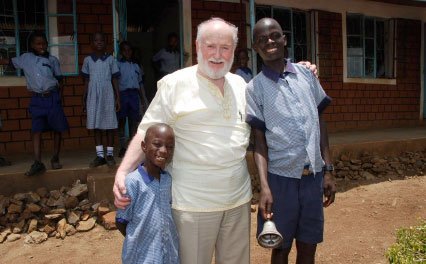
Siloam Worker, Martin Mackenzie, with two of the children from the school. Martin says “Currently the youngest child is 3 ½ although the normal admission age is 5. The oldest is 17 despite the fact that primary education, which is free, ends at 13 when they take an exam for the Kenya Certificate of Primary Education. The official title of the school still includes the words “late starters” and a reducing number still are. The first Head Boy (now known as “President”) that I knew was 18 when he went on to secondary school. He was found abandoned by a British couple who brought him to Lambwe aged 11. Benson represented Kenya in the relay event of the Paralympics in Bulgaria in 2015.”
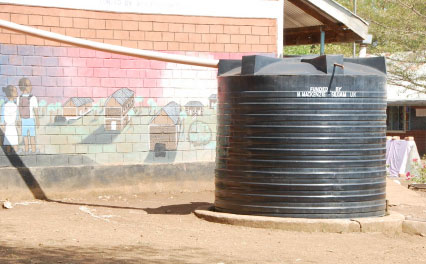
This mural was painted by a Peace Corps Volunteer and is on the end of the first classroom block to be built. It does not show the incline of the land which can be judged by comparing the elevation of this building with the one in the background beyond the assembly area. In the mural, on the far left is the boys’ dormitory (see photo of the Tandem System). Then we see the workshop building before the tanks were installed and then the building on which the mural is painted. Behind the bush indicating the assembly area is the now demolished dining-cum-games room (now being rebuilt) and the end of the girls’ dormitory which is mostly obscured by the tank, to the right of which can be seen the memorial to Nelda Kroll awaiting unveiling.
The back of the workshop building shows the large area of roof from which we still need to harvest the rain. The corrugated iron building is the temporary carpentry workshop.